Why We’re Rebuilding The Dragon Slayer

Updated: Aug 7
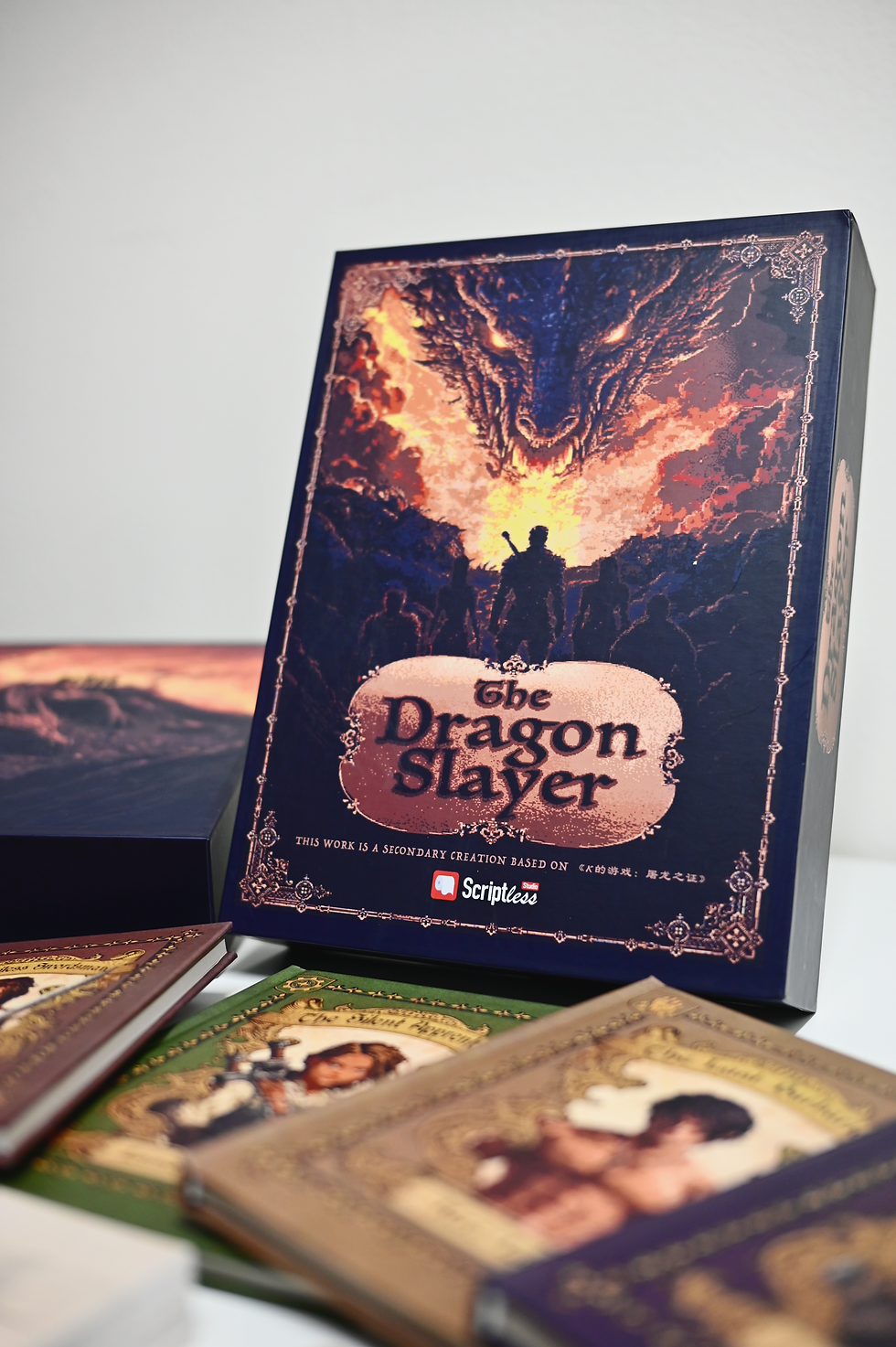
Sometimes, you need to take a step back in order to move forward
The first edition of The Dragon Slayer was released two years ago.
At the time, The Dragon Slayer was just a small project between friends. We loved Jubensha and wanted to create something that could introduce English-speaking players to the format’s depth, tension, and emotional power. So we decided to make our own game: something that could be played in under three hours, with a balance of mystery, mechanics, and character-driven storytelling.
After nearly three months of waiting, we finally saw the first printed copies. The colors came out beautifully, just as we had hoped, and the binding gave each script the feeling of a finely crafted storybook. To us, it felt special — almost like a custom-made fairy tale. At that moment, we truly believed this was the kind of product that could move people who loved Jubensha.
That was how The Dragon Slayer was born.
In the Dragon-Slaying Kingdom, the war between humans and dragons has lasted for generations. To end the endless bloodshed, both sides turned war into a brutal game: a hero who rescues the princess can become king, while the dragon who captures her will be crowned leader of the dragons.
On the surface, The Dragon Slayer felt like a familiar fairy tale: dragons, kingdoms, and a princess waiting to be saved. But underneath that story was something far more complicated — a world of secrets, motives, and truths waiting for players to uncover.
One of our goals was to reduce the amount of story players would need to read in one go, while also giving them a natural way to break the ice and begin interacting with one another. So, we broke the script into parts (acts, if you will), with mini-games between sections to give players a chance to digest what they’ve read and role-play with the new information.
After the first edition was completed, we tested it nearly 50 times. Many players responded with real enthusiasm, which showed us that the game had potential. But some of our most dedicated players also gave us thoughtful suggestions that pushed us to look at the game more honestly.
Some characters did not feel closely connected enough.
Some story details were introduced but not meaningfully developed through clues.
The mechanics worked, but they did not give players enough freedom.
The English writing also had moments where the grammar, tone, and style did not fully match the experience we wanted to create.
Most importantly, the original version of The Dragon Slayer was designed for freelance hosts and Jubensha cafés. Because of that, it depended heavily on a GM to guide the experience. Without a GM, the game was difficult to run smoothly. And for the GM, the role was often more about managing the flow of the game than enjoying the story as a participant.
Our goal, above all else, is to have people sit down with their friends and enjoy Jubensha the way we do. But most people don’t know what Jubensha is. And with out that experience at the table, players can struggle with the “right-way” to play a Jubensha.
That became the biggest problem we wanted to solve.
Over the past year, we have reviewed player feedback, studied what worked and what did not, and reconsidered what English-language Jubensha can become. And with new members joining the team and a clearer vision for the future, we decided it was time to rebuild The Dragon Slayer.
This is not just a polished second edition.
We want to create a game that is strong enough to help players fall in love with Jubensha.
The new edition of The Dragon Slayer will preserve the strongest parts of the original while reworking the story structure, character relationships, player choices, mechanics, and overall flow. We are also redesigning the game so it can be played without a required GM.
But at the same time, we are not simply removing the GM role. Instead, we are reimagining it as an optional special role with its own way to participate in the experience. This means The Dragon Slayer can be played with either five or six players, with every participant taking on a meaningful place inside the story.
In The Dragon Slayer, every character begins a journey.
Script Lab is beginning one too, by returning to this game with everything we have learned so far.
This is the next chapter for
The Dragon Slayer.
And for us.
Join us won’t you?
Instagram: script_lab_co
Website: www.scriptlabco.com
Discord: https://discord.gg/8XntfGJYQz


Comments