Why a Great Game Is Never Made by One Person

A great Jubensha (A mystery role-playing game) is never the work of one person.
It may begin with one idea, one story, or one moment of inspiration—but turning that idea into a complete experience takes far more than I understood when I first started Script Lab.

A finished Jubensha has to pass through many hands.
There is the writing itself. The design of the mystery. The logic behind every clue. The game mechanics and player experience. The artwork. The website. Manufacturing. Supply chain. Shipping. Marketing. Community building.
And somewhere between all of those things, an idea slowly becomes something real—something that can sit on a table in front of a group of players and, for a few hours, become a world they truly believe in.
When I first started the company, I was far too optimistic about how that happened.
I thought that if the idea was good enough, everything else would somehow follow.
It took me a long time to understand how wrong I was.
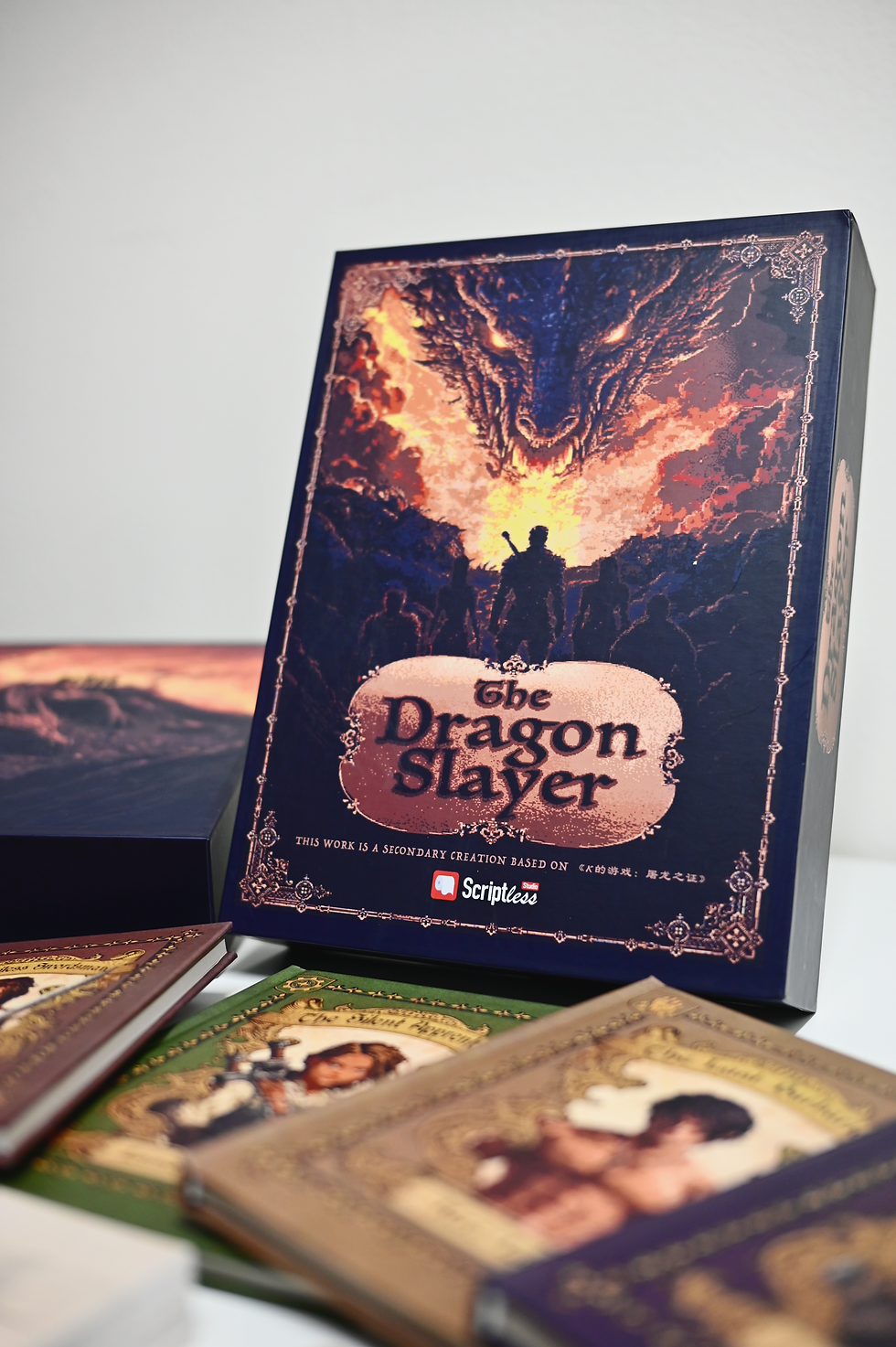
And nothing made that realization clearer than rebuilding The Dragon Slayer for its Second Edition.
I wrote the First Edition myself.
For a long time, I genuinely believed it was already a good game. It certainly wasn't perfect. There were details that did not hold up under close scrutiny, and there were places where the logic could have been stronger. But as an overall experience, it worked.
After more than one hundred sessions, the majority of the feedback was positive.
Players had fun.
They remembered the story.
They talked about the characters afterward.
So in my mind, the game had already proven itself.
Then the new Script Lab team began working on the Second Edition.
We started having long, intense discussions about nearly every part of the game—its story, its logic, its pacing, its mechanics, its presentation.
And that was when I began to understand something I had never fully appreciated before:
A good collaborator does not simply help you finish your idea.
They show you possibilities inside your own work that you could never have discovered alone.
My own background in Jubensha goes back about five years, but writing has never been my greatest strength.

For most of that time, I worked much more as a GM than as an author. I loved taking a great story and presenting it to players in the best possible way—reading the room, controlling the pacing, building atmosphere, and helping people become completely immersed in the experience.
Compared with writing, I have always been more comfortable with the business side of things.
And that is exactly why building the right team changed everything.
Ariel—also known as Black Cat—seems, very appropriately, to approach our games almost like a witch examining a spell.

She has an unusual ability to look at a problem from an angle the rest of us have completely missed.
More importantly, she refuses to let unexplained logic survive.
If something happens in the story, there must be a reason.
If a character makes a decision, that decision must make sense.
If a clue exists, it must belong there.
If two pieces of information contradict each other, we cannot simply hope the players will not notice.
Some people might call that perfectionism.
Maybe it is.
But if we believe that Jubensha can be a form of art, then shouldn't we treat every detail as if it matters?
Herning also brings something completely different to the team.

As an experienced graphic designer and English-language fiction writer, she has a way of seeing beyond the boundaries the rest of us unconsciously create.
Sometimes, after hours of discussion, the rest of us will find ourselves trapped inside the same set of assumptions. We keep trying to solve the problem from within the framework we already have.
Then Herning will suggest something that changes the framework entirely.
Those moments are often where some of our best ideas come from.
She is also responsible for the visual design of the game.
I still remember the first time I saw the production guide she prepared for the printing factory.
I was stunned by the level of detail.
Measurements, materials, colors, layouts, specifications—things I would never have thought to document were considered carefully and communicated precisely.
That was another moment when I realized the difference between having an idea and creating a product.
Ideas can be exciting.
But details are what make them real.
Working on The Dragon Slayer: Second Edition has changed the way I think about game creation.
A strong Jubensha is not created during one brilliant brainstorming session.
It is built through countless conversations.
Through arguments over tiny inconsistencies.
Through ideas that are discarded after days of work.
Through revisions of revisions.
Through late-night messages, production files, prototypes, playtests, spreadsheets, shipping calculations, and questions that somehow create three more questions every time they are answered.
It takes months of concentrated work.
But more than anything, it takes a group of people who believe the finished experience is worth that effort.
That belief matters.
Because there are always moments when the work becomes exhausting. Moments when solving one problem reveals five others. Moments when it would be much easier to say, "This is probably good enough."
A great team is what keeps "good enough" from becoming the final answer.
Looking back, I used to think building a Jubensha meant turning an idea into a game.
Now I think about it differently.
It means bringing together people who care deeply about different parts of the same experience—and trusting them enough to make the work better than anything you could have created alone.
The Dragon Slayer: Second Edition may have started from a story I wrote.
But what it is becoming belongs to all of us.
And I think that is what makes me most excited to finally share it with the world.
Follow Script Lab for more behind-the-scenes stories about how we create, rebuild, and obsess over every detail of our Jubensha games.


Comments